
France, the Gulf, and the Architecture of Trust in Health
Global Health Stratalogues named Intelligence Partner of the Global Health Exhibition, with a market report unveiled at Vision Golfe Summit at the French Ministry of Economy
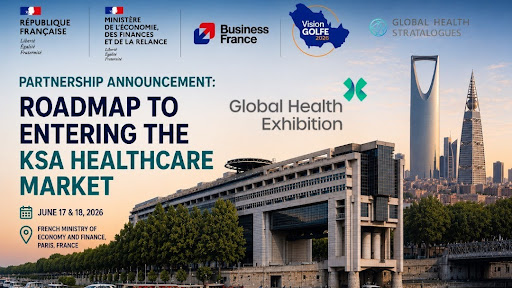
At Vision Golfe, the France-Gulf economic summit held at the French Ministry of Economy and Finance in Paris on 18 and 19 June, Oscar Wendel announced a strategic partnership where Global Health Stratalogues joins the Global Health Exhibition in Saudi Arabia as its official Intelligence Partner to help international companies enter one of the world’s fastest-growing healthcare markets.
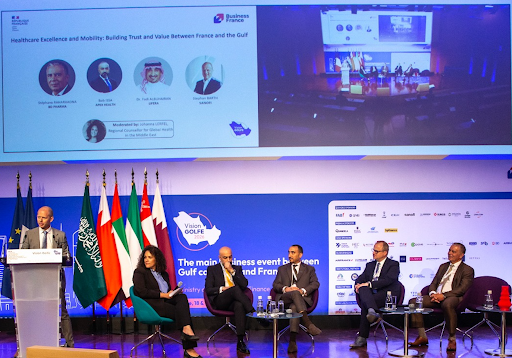
Senior leaders gathered as Global Health Stratalogues, the Global Health Exhibition, and Business France set out a shared roadmap for international companies entering the Kingdom’s healthcare market. The partnership was announced at the healthcare panel and will continue through to the ninth Global Health Exhibition in Riyadh.
The flagship output of that partnership is a market intelligence report, “Roadmap to Entering the KSA Healthcare Market: A Strategic Guide for International Companies,” produced by Global Health Stratalogues with the support of Business France, and MedEdge MEA as Media Partner and published in partnership with the Global Health Exhibition. Previewed in Paris, the report will be distributed as an official knowledge product at the ninth edition of the Global Health Exhibition, taking place from 26 to 29 October in Riyadh, where it will reach more than 130,000 healthcare professionals and over 2,200 exhibiting brands. There, the partners will convene the Global Stratalogues Roundtable, an invitation-only session curated with Business France, that brings together senior healthcare leaders, policymakers, and innovators for a working dialogue on the Kingdom’s health future.
The logic of the partnership is structural. “Our partnerships create an integrated system across three layers,” said Sunita Khatri, Show Director of the Global Health Exhibition. “Business France provides the institutional channel into Saudi Arabia, the GCC’s largest healthcare market. The Global Health Exhibition provides the audience and a deal-making environment. And Global Health Stratalogues with MedEdge MEA provide the media layer that sustains and amplifies those conversations year-round.”
The timing was deliberate, and the conversation that preceded the announcement made its case more persuasively than any pitch could have.
The session that framed the announcement, “Healthcare Excellence and Mobility: Building Trust and Value Between France and the Gulf,” was moderated by Johanna Lerfel, Regional Counsellor for Global Health in the Middle East at Business France. She had assembled four practitioners who, between them, covered most of the value chain: a biopharma localisation platform, a global vaccines franchise, a cross-border hospital operator, and a maker of the injectable devices on which pharmaceutical companies depend.
Dr. Fadi Albuhairan, Chief Executive of LIFERA, described his company’s role as a catalyst across three verticals: biologics, where the localisation of insulin is already underway; genomics, where the challenge is to sequence and then leverage the resulting data; and gene therapy, slated to begin in 2027. Access to the Saudi market, he argued, already exists and requires no partner. The work worth doing is the advancement of quality, the maturing of regulation, and the leapfrogging that becomes possible when partners build on an existing foundation rather than from scratch.
Stephan Barth, global franchise lead at Sanofi for pneumococcal, meningococcal, travel and endemic vaccines, reminded the room that Sanofi has been present in the region for over fifty years and was the first company to localise manufacturing there. His emphasis fell on seriousness and sequence: commitment, in his telling, is demonstrated through prioritisation, through mobilising the entire value chain from research to manufacturing, and through a readiness to be challenged on standards rather than defensive about them. He returned, more than once, to the France-Gulf relationship as a competitive advantage that French companies should treat as exactly that.
Bob Issa, Chief Marketing Officer of APEX Health, brought the discussion to operational ground. The Qatari company has moved in three years from zero to eight hospitals across four countries, with further expansion planned before year end. His formulation was the one most likely to be quoted afterward: you build with the market, not for the market. A hospital opening in Algeria within the year will, from its first day, draw its supply chain and its talent locally, because the alternative is to extract value rather than to create capacity. He was careful about pace: build capacity faster than capability and you manufacture dependency; build capability without the capacity to sustain it and you forfeit advantage. The two must rise together.
Stephane Raharijaona of BD, whose pharmaceutical systems division supplies the glass pre-fillable syringes that manufacturers increasingly require, offered a long-view perspective on the injectables market. Fifteen years ago, he noted, only one or two companies in the region produced injectables locally; today, there are many. Localisation has become the baseline expectation, quality the opening question rather than a later one, and Gulf companies are reaching directly for the complex therapies, the monoclonal antibodies and the treatments for chronic disease, that define the current frontier.
Across the four contributions, what was striking was how little of the discussion concerned selling and how much concerned the conditions under which trust becomes durable. The answers converged on regulation that keeps pace, a population young enough that capability is a question of investment rather than scarcity, and partners willing to align on long-term aspiration rather than transaction.
That is precisely why the report and the roundtable matter. The Gulf market does not lack ambition, capital, or talent. What international companies often lack is a clear-eyed account of how the system actually works: where regulation is moving, what localisation genuinely requires, and how trust is earned rather than assumed.
The France-Gulf health relationship is entering a phase defined less by access and more by architecture, and Wendel’s announcement, set against the panel that produced it, was a deliberate answer to the question of what each party is now prepared to build.
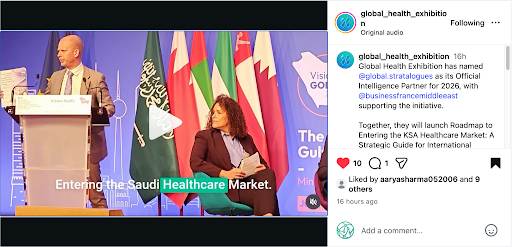
Video announcement on Global Health Exhibition Instagram
https://www.instagram.com/reel/DZ-hMceOKP-/?igsh=bzhsZnc2bHA2MW1x
The panel made the case for that report more effectively than any product launch could have. The Saudi healthcare market is not short of opportunity. What international companies consistently underestimate is the sophistication of what is now required to operate there well, the regulatory intelligence, the localisation expectations, and the pace of ambition. The France-Gulf health relationship is entering a phase defined less by market entry and more by the architecture of what comes next.
Media Contact
Global Health Stratalogues
[email protected]
+971585943210
www.HealthStratalogues.com